Event/News

HOME > POST > Multiscale Modeling for Numerical Prediction of Bonded CFRP Structural Strength

Multiscale Modeling for Numerical Prediction of Bonded CFRP Structural Strength

news

【Researcher Information】

Yamato Hoshi, Assistant Professor, the Research Center for Green X-Tech, Green Goals Initiative, Tohoku University

Website

【Research Highlights】

・With the goal of reducing aircraft weight, there is growing anticipation for bonded structures (Note 2) that join composite materials such as CFRP (Note 1) using adhesives instead of bolts.

・We have developed a multiscale analysis (Note 3) model to predict the strength of bonded CFRP structures, accounting for the effects of modifiers (rubber particles) added to the adhesive on its internal damage and deformation.

・This model is expected to serve as a guideline for designing the optimal amount of modifier (Note 4) additives based on numerical analysis, a process that traditionally relied heavily on experimental trial and error.

【Overview】

In transport equipment, including aircraft, further reduction in structural weight is demanded to improve fuel efficiency and reduce carbon dioxide emissions. For next-generation aircraft in particular, there is growing anticipation for bonded structures that join CFRP (Carbon Fiber Reinforced Plastics) with adhesives, thereby reducing mechanical fasteners (Note 5) such as structural bolts. Epoxy resins (Note 6), known for their excellent heat resistance and mechanical properties, are widely used for aircraft adhesives. However, because epoxy resins are brittle, modifiers such as rubber particles are added to improve toughness (Note 7). On the other hand, predicting how the properties of the adhesive and the strength of the bonded structure change depending on the amount of modifier added has been difficult, traditionally requiring repeated experimentation to find the optimal conditions.

A research group led by Assistant Professor Yamato Hoshi at the Research Center for Green X-Tech, Green Goals Initiative, Tohoku University, has developed a multiscale analysis model. This model links a microscopic model representing damages that occur around modifiers with a macroscopic model representing the failure of the entire bonded structure composed of the adhesive and CFRP. Furthermore, focusing not only on the adhesive strength but also on the toughness—which indicates the resistance to fracture propagation—the group clarified the mechanism of adhesive strength enhancement through modifier addition from both experimental and numerical analysis perspectives. The insights obtained in this study are expected to reduce trial and error in adhesive development and contribute to the design of highly reliable bonded structures.

These research results were published in the academic journal International Journal of Solids and Structures (IJSS) on June 20, 2026.
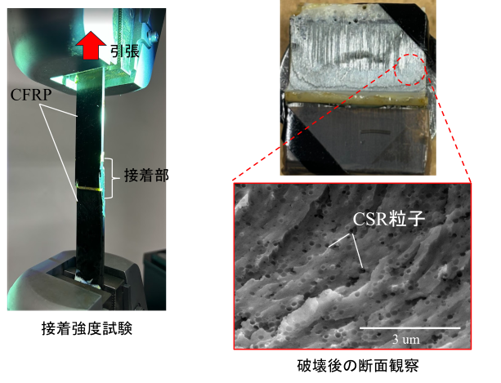
Figure 1. Adhesive strength test conducted in this study. Traces of CSR particles are visible on the fractured adhesive surface.

【Glossary】

Note 1. CFRP (Carbon Fiber Reinforced Plastic): A composite material consisting of carbon fibers embedded in a resin matrix. Known for its lightweight and high-strength properties, it is widely used in aircraft, automobiles, and sporting goods.

Note 2. Bonded Structure: A structural configuration where components are joined using adhesives instead of mechanical fasteners such as bolts or rivets. Since it reduces the need for drilling holes, it is expected to achieve weight reduction and mitigate stress concentration.

Note 3. Multiscale Analysis: An analytical method that links microstructural phenomena occurring inside a material with the macroscopic deformation and failure of the entire structure. In this study, microscopic deformation and damage around CSR particles are evaluated, and the results are integrated into the strength prediction of the overall bonded CFRP structure.

Note 4. Modifier: A substance added to materials such as resins to improve properties including toughness, flexibility, and impact resistance. In this research, it primarily refers to rubber particles.

Note 5. Mechanical Fastening: A method of securing components using bolts, rivets, screws, or other mechanical hardware. It is extensively utilized in aircraft structures.

Note 6. Epoxy Resin: A type of resin characterized by its excellent heat resistance, adhesion properties, and mechanical characteristics. It is widely used as an aircraft adhesive and as a matrix resin for composite materials.

Note 7. Toughness: A material property that represents resistance to cracking or fracture propagation. Even if a material has high strength, low toughness can lead to catastrophic, rapid failure once a crack initiates.

【Publication Information】

Title: Multiscale Modeling of Toughening in Thermosetting Resins Based on a Microscopic Damage Model: Application to Bonded CFRP Structures

Authors: Yamato Hoshikawa*, Sera Koo, Yoshiaki Kawagoe, Shoko Mishima, Kazuki Ryuzono and Tomonaga Okabe

*Corresponding Author: Yamato Hoshikawa, Assistant Professor, the Research Center for Green X-Tech, Green Goals Initiative, Tohoku University

Journal: International Journal of Solids and Structures

DOI:10.1016/j.ijsolstr.2026.114159

Click here for more details