
Toyoda Gosei and Tohoku University Launch Collaborative Research on Functional Materials — Accelerating the development of high-performance materials for safety, comfort, and decarbonization —
National University Corporation Tohoku University and Toyoda Gosei Co., Ltd. established the “Toyoda Gosei × Tohoku University Co-creation Research Center for Functional Materials Connecting Safety, Comfort, and Decarbonization” on the Aobayama Campus of Tohoku University on July 1, 2026.
This Co-creation Research Center will advance advanced research activities through industry-academia collaboration, using the adjacent “3GeV High-Brilliance Synchrotron Radiation Facility NanoTerasu” as a hub, to promote the development of high-functional materials that contribute to safety, comfort, and decarbonization.
At the Research Center for Green X-Tech, we will also leverage research achievements in advanced measurement technology and materials science to even more strongly propel cross-disciplinary collaboration and industry-academia co-creation efforts toward the realization of a sustainable society.
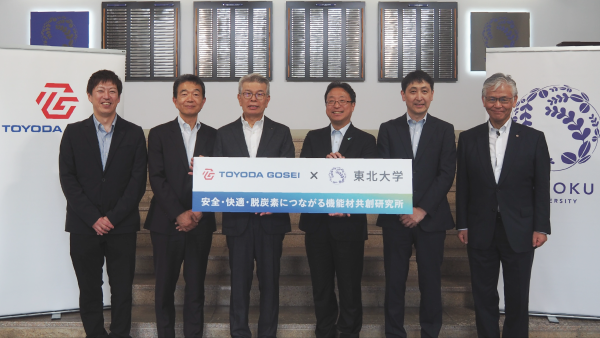
From left: Mr. Okawa (General Manager), Mr. Nakanishi (Advisor), Mr. Yasuda (Executive Vice President), Dr. Toyama (Executive Director), Dr. Okabe (Center Director), and Dr. Takada (Associate Executive Director)