
Elucidating the Mechanism of Enhanced Solvent Resistance in Polymers for High-Frequency Electronic Substrates: Insights into 3D Network Formation via Simulation
Polyphenylene ether (PPE) is drawing significant attention for high-frequency electronic substrates in 5G/6G systems due to its superior low dielectric properties. However, achieving both high processability and post-cure solvent resistance has remained a longstanding hurdle.
A research group led by Associate Professor Yoshiaki Kawagoe (corresponding author) at the Research Center for Green X-Tech, in a joint study with Taiyo Holdings Co., Ltd., implemented an approach combining “experimental evaluation” and “thermosetting simulation” for reactive PPE materials. As a result, they successfully elucidated the mechanism through which superior solvent resistance emerges after curing.
Specifically, they revealed that the reactive allyl groups introduced into the PPE react with the thermosetting component (TAIC) during the curing reaction, forming a robust three-dimensional network structure that allows the material to maintain its shape even when immersed in a solvent.
These results provide molecular design principles for high-reliability next-generation low-loss polymer materials and are anticipated to contribute to accelerating material development through simulation-driven approaches, including materials informatics.
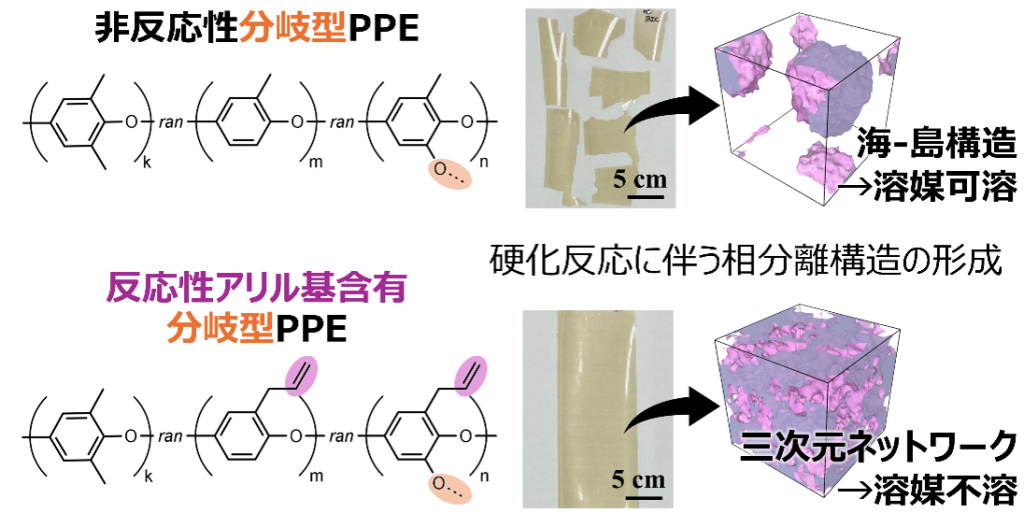
The research findings were published in the Royal Society of Chemistry’s journal Polymer Chemistry on July 28, 2026.
[Glossary]
Title: Synthesis of Allyl-Functionalized Branched Poly(phenylene Ether) Enabling Network Formation and Solvent Resistance: An Experimental and Curing Dissipative Particle Dynamics Study
Authors: Shoko Mishima, Yoshiaki Kawagoe, Kaho Shibasaki, Nobuhiro Ishikawa, and Tomonaga Okabe
*Corresponding Author: Yoshiaki Kawagoe, Associate Professor, the Research Center for Green X-Tech, Organization for Creating Green Future, Tohoku University
Journal: Polymer Chemistry
DOI: 10.1039/D6PY00585C